
First frames and filmstrips
Three functions of the media front return pictures as Rgba (8-bit RGBA, width, height, data), scaled to the height you ask for with the width following the picture’s shape and rotation.
The first frame
Section titled “The first frame”use pito_codecs::media::{Prefs, first_frame};
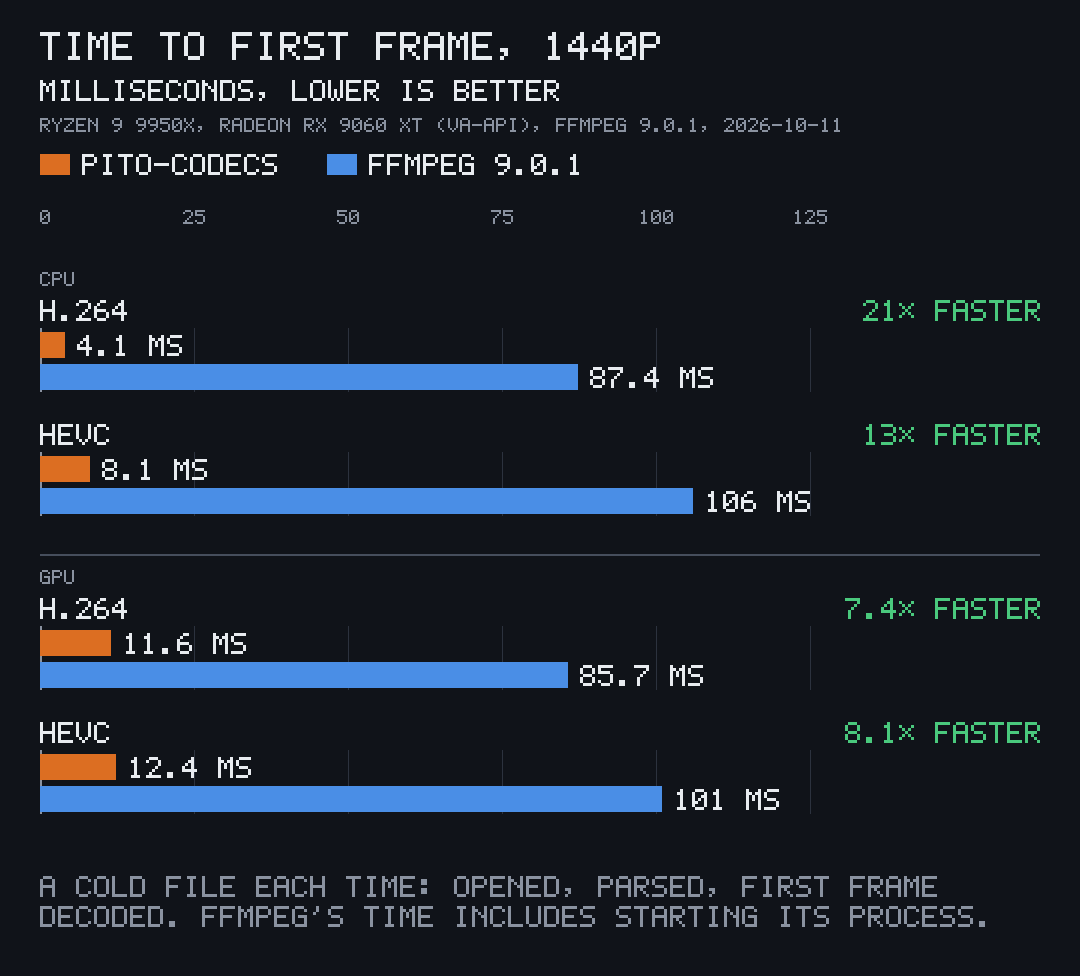
let still = first_frame("clip.mp4".as_ref(), 240, &Prefs::default())?;first frame 426x240 in 52.9 msThat time is a cold start in a fresh process on a busy machine; the README’s measured run gives 4.1 ms for 1440p H.264 on the CPU and 12.4 ms for HEVC on the GPU, 7× to 21× sooner than ffmpeg.
A filmstrip
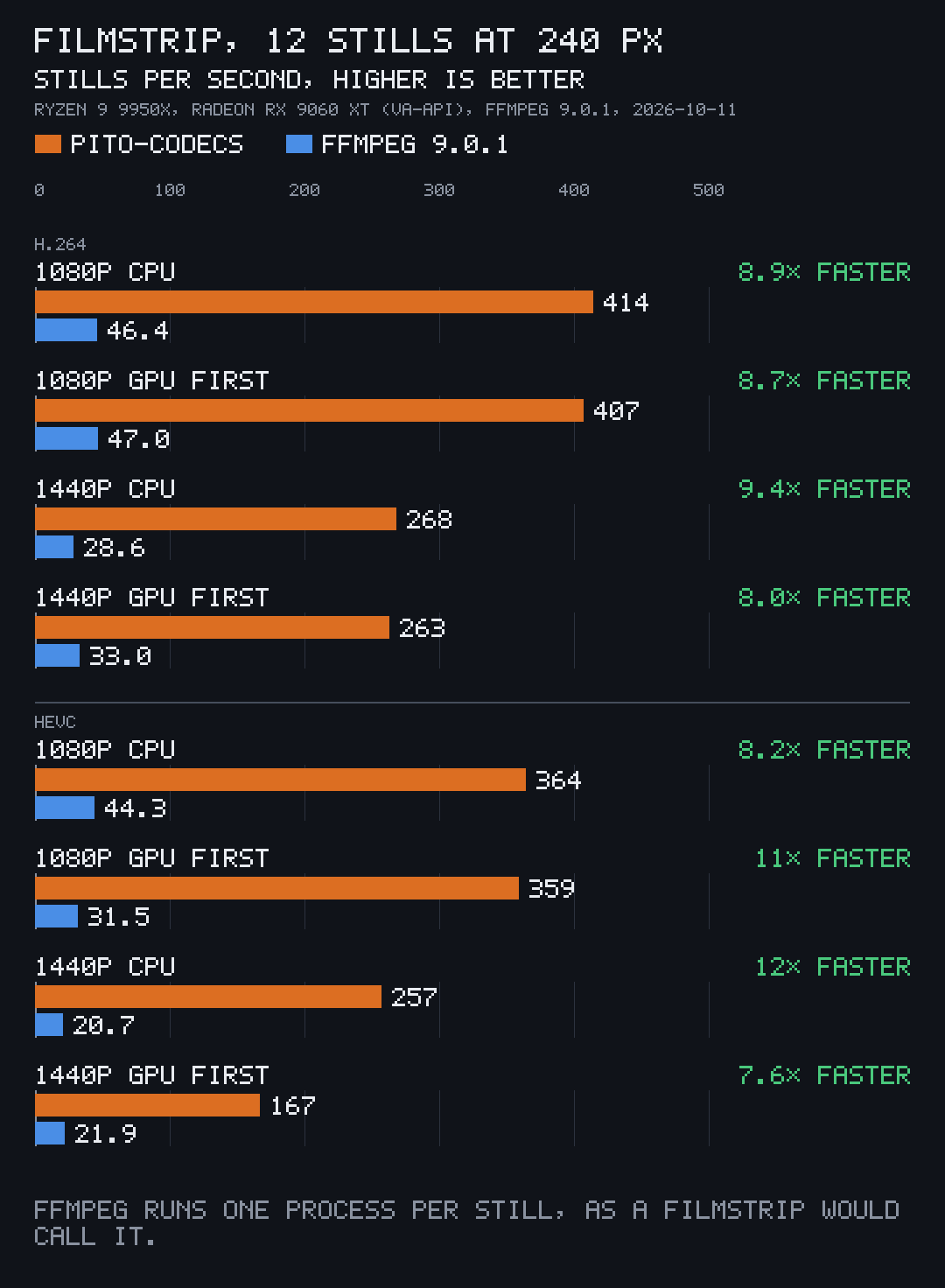
Section titled “A filmstrip”frames_at takes a still at each time you give, in seconds. Each still is the keyframe at or before its time, which is what a filmstrip wants, and only the packets it needs are read. The stills are decoded in parallel.
use pito_codecs::media::{Prefs, frames_at, probe};
let prefs = Prefs::default();let info = probe("clip.mp4".as_ref(), &prefs)?;let times: Vec<f64> = (0..12).map(|i| info.duration * i as f64 / 12.0).collect();let strip = frames_at("clip.mp4".as_ref(), ×, 120, &prefs)?;12 stills at 212x120 in 57.7 msIn MKV and WebM, stills seek through the file’s Cues, so a still late in a long recording costs the same as one at the start.

The exact frame
Section titled “The exact frame”frames_at_seek with Seek::Exact decodes on from the keyframe to the frame shown at each time. Times inside one group of pictures share one decode.
use pito_codecs::media::{Prefs, Seek, frames_at_seek};
let exact = frames_at_seek("clip.mp4".as_ref(), &[2.5, 2.6, 7.25], 240, Seek::Exact, &Prefs::default())?;
3 exact stills in 300.0 msSeek::Keyframe is the default and is what frames_at uses. An exact still costs more the further its time is from the keyframe before it: the clip above has a keyframe only every few seconds.
Save a still
Section titled “Save a still”Encode a still as WebP or GIF with the library’s own encoders:
use pito_codecs::webp;
let data = webp::encode(&still, &webp::Options::lossy(80.0))?;std::fs::write("first.webp", &data)?;
Low-level codecs has more on GIF and WebP. To read every frame rather than stills, use decode_video (frames in system memory) or decode_video_gpu (frames that stay on the card when the GPU decodes); both start at any time and can scale to a height.