
pito-codecs
Video and audio codecs in pure Rust, on the CPU and the GPU, with no ffmpeg inside. H.264, H.265, VP9, AAC, AC-3, E-AC-3, Opus and MP3; MP4, MOV, MKV and WebM; GIF and WebP. One MIT Cargo package, a feature per part, two direct dependencies and no C linked.
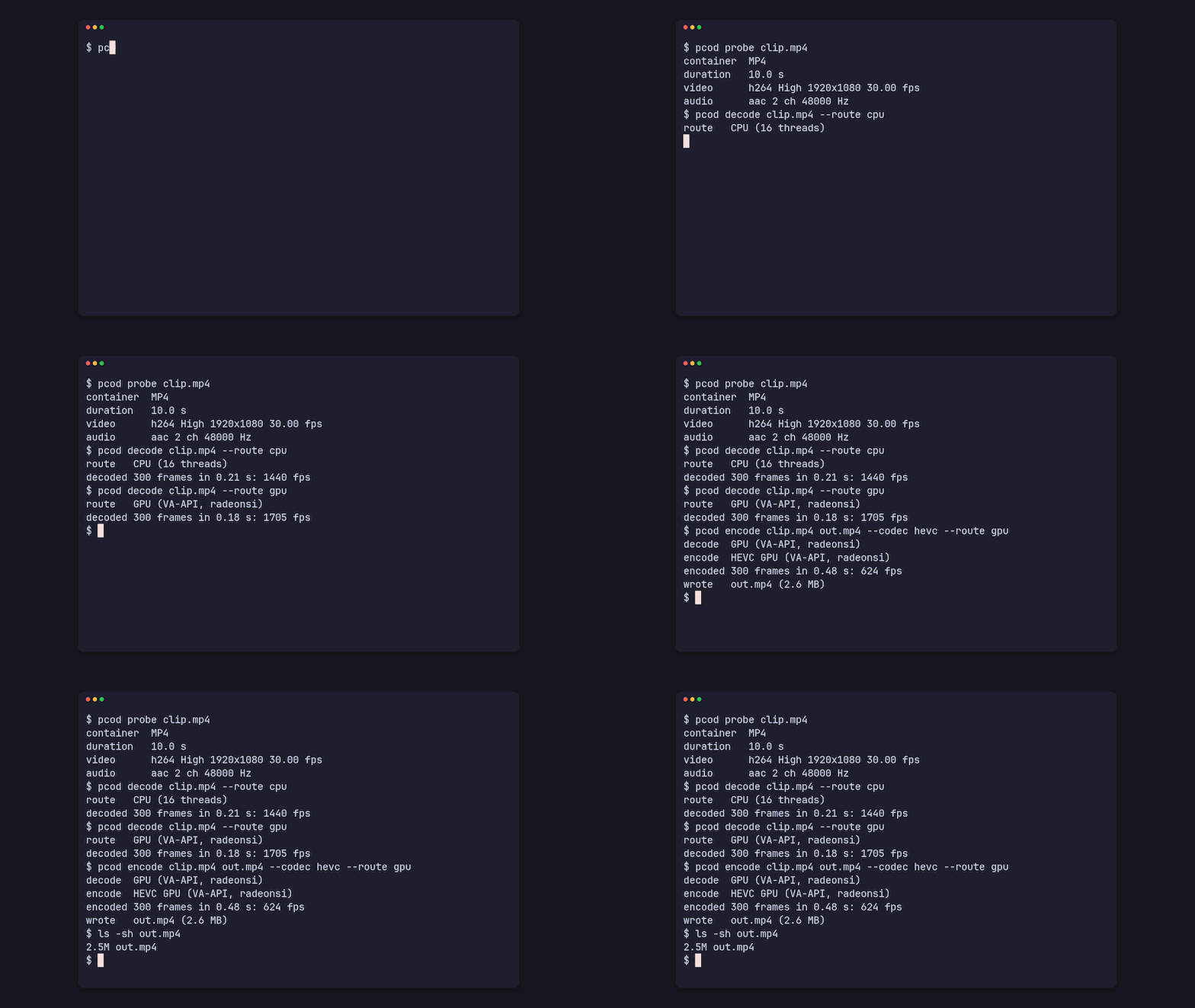
It comes as a Rust library and as pcod, a small command line over it that probes, decodes and encodes MP4 files.
- First frame 7× to 21× faster than ffmpeg: 4.1 ms against 87.4 ms for a 1440p H.264 file on the CPU.
- Filmstrips 8× to 12× faster: 12 stills at 240 px in 29 to 72 ms.
- Frame-accurate smart cuts 1.7× to 2.9× faster than an ffmpeg re-encode: only the frames around each cut are encoded.
- GPU decode and encode on VA-API 1.1× to 1.3× faster than ffmpeg’s, and frames can stay on the card from decode to encode.
- Overlays composed on the card: a marked or captioned export uses 18× to 23× less CPU time than decoding and blending on the CPU.
- Small: a 3.9 MB command line, and a library that pulls in 8 crates on Linux.
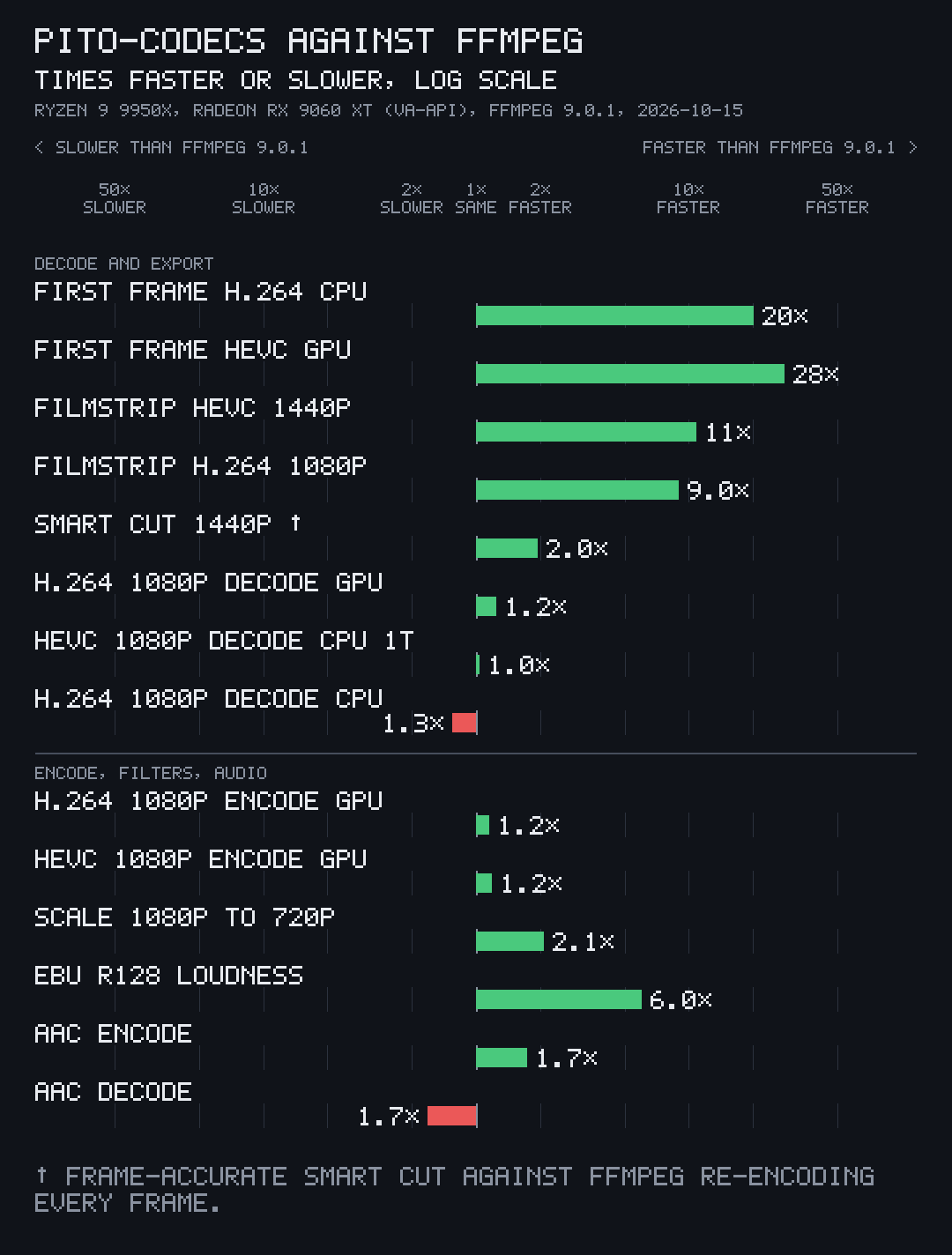
Every speed number here was measured on one machine (AMD Ryzen 9 9950X, AMD Radeon RX 9060 XT on Mesa’s radeonsi VA-API driver, Linux, ffmpeg 9.0.1) on public-domain NASA footage. The repository’s README gives the input, the commands and the load for each.
Where to start
Section titled “Where to start”- Install pcod or add the library to a Rust project.
- Probe, decode and encode with pcod from a terminal.
- Use the library: the
mediafront picks the fastest route for each job and says why when it falls back. - First frames and filmstrips, audio as PCM, smart-cut exports, overlays and captions and exports of your own frames.
- GPU routes per vendor and system: what is tested and what is built but untested.
- Low-level codecs: H.264 decode and encode, GIF and WebP without the front.
- The command reference, the formats and the API reference.
Licence
Section titled “Licence”The code is MIT licensed, © Catalin Ilinca. The PITO MD name and its logos are © Catalin Ilinca, all rights reserved, and are not covered by the MIT licence. pito-codecs is the media layer of PITO MD; its source is at github.com/gmrdad82/pito-codecs.