
Export an edit with smart cuts
export writes an edit, a list of Pieces, to an MP4. Each piece is a time range of a file:
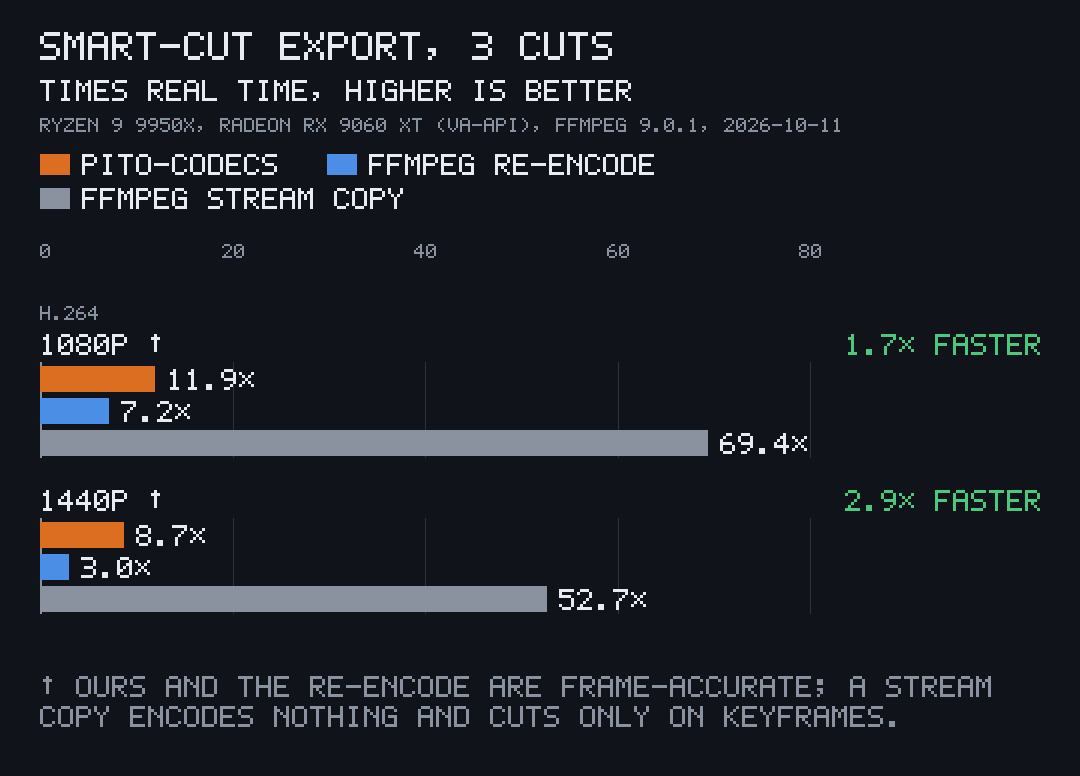
pub struct Piece { pub path: PathBuf, pub from: f64, pub to: f64,}The export is frame-accurate and fast: where it can, it copies the middle of each piece as it is and re-encodes only the frames from each cut to the next keyframe. That is a smart export, and it ran 1.7× to 2.9× faster than ffmpeg re-encoding every frame.
A three-piece cut
Section titled “A three-piece cut”use pito_codecs::media::{ExportOptions, Piece, export};
let clip = std::path::PathBuf::from("clip.mp4");let pieces = vec![ Piece { path: clip.clone(), from: 0.5, to: 2.75 }, Piece { path: clip.clone(), from: 4.1, to: 6.3 }, Piece { path: clip.clone(), from: 8.0, to: 9.6 },];let done = export("edit.mp4".as_ref(), &pieces, ExportOptions::default(), |progress| { println!("{:?} {:.0}%", progress.stage, progress.done * 100.0); true})?;println!("{} frames, {} copied, {} encoded, smart {}, video {}", done.frames, done.copied, done.encoded, done.smart, done.video.said());for r in &done.reasons { println!(" reason: {r}");}On the 10-second 1080p60 clip from the pcod guide:
362 frames, 200 copied, 162 encoded, smart true, video H.264 GPU reason: frames stay on the GPU from decode to encode through VA-APIThe progress callback gets a Progress with the stage (Cutting, Encoding, Mixing, Joining), done from 0.0 to 1.0 and the encoder’s route; returning false cancels the export with Error::Cancelled. The pieces can come from different files.
ExportOptions
Section titled “ExportOptions”pub struct ExportOptions { pub video: Codec, pub crf: u8, pub audio_kbps: u32, pub audio_gains: Vec<f32>, pub overlay: Option<Overlay>, pub prefs: Prefs,}video is the output codec (Codec::H264 by default, Codec::Hevc or Codec::Vp9), crf the quality of the encoded frames (18 by default), audio_kbps the AAC rate (192), audio_gains a gain per source audio track for the mix, overlay a picture drawn on every frame (Overlays and captions) and prefs the routes.
What the reasons say
Section titled “What the reasons say”Exported returns the frame counts, whether the export was smart, the video route as Picked, and reasons: one sentence for each thing that made the export slower than the best case, or that an app may want to show. The export is re-encoded whole, and says why, when:
- an overlay is drawn on every frame;
- the source codec differs from the export’s, such as an H.264 source exported as HEVC: “the source video is h264, the export HEVC, so the whole export is re-encoded”;
- the pieces’ files differ in frame rate, size, bit depth or rotation;
- a VP9 source is not profile 0 at 8 bits, since our VP9 encoder writes only that;
- the picture has an odd width or height, which is evened;
- our MP4 and MKV readers can’t index a source to copy from it.
Other reasons tell the route: a GPU encoder that failed and was replaced by H.264 on the CPU, an HEVC fallback, or that frames stay on the GPU from decode to encode.
A VP9 source in WebM or MKV, exported with video: Codec::Vp9, cuts the same way into MP4 (vp09): packets are copied as they are, superframes included, and only the frames before each piece’s first keyframe are encoded, on the CPU, in parallel keyframe-led chunks.
let opts = ExportOptions { video: Codec::Vp9, ..ExportOptions::default() };let done = export("edit-vp9.mp4".as_ref(), &pieces_of_the_webm, opts, |_| true)?;362 frames, 158 copied, 204 encoded, smart true, video VP9 CPUWith your own audio
Section titled “With your own audio”export copies and mixes the sources’ audio. To write audio you mixed yourself, export_with_audio calls back for each piece with its index and its exact sample count, and takes that many 48 kHz stereo samples, which our AAC encoder turns into one track as long as the video to the sample:
use pito_codecs::media::{AudioBuffer, ExportOptions, export_with_audio};
let done = export_with_audio(    "edit.mp4".as_ref(),    &pieces,    ExportOptions::default(),    |piece, samples| {        let mut buf = AudioBuffer::new(48_000, 2);        buf.samples = mixer.render(piece, samples);        Ok(buf)    },    |_| true,)?;
Here mixer stands for your own code; it must return samples frames of interleaved stereo, samples * 2 floats.