
Audio as PCM
The media front decodes audio tracks to 32-bit float PCM at the rate and channel count you ask for, resampling and downmixing on the way. The result is an AudioBuffer with samples (interleaved), rate and channels.
Which codecs
Section titled “Which codecs”AAC-LC, Opus (SILK, CELT, hybrid and multistream), AC-3, E-AC-3, MP3, MP2, MP1 and PCM, from MP4, MOV, MKV and WebM. AudioTrack::native() says whether pito-codecs decodes a track itself. A track in another codec (FLAC, Vorbis, DTS, ALAC) decodes only through the user’s ffmpeg, when the app’s Prefs pick it.
use pito_codecs::media::{Prefs, probe};
let info = probe("tracks.mkv".as_ref(), &Prefs::default())?;for t in &info.audio {    println!("track {}: {} {} ch {} Hz, ours: {}", t.index, t.codec, t.channels, t.rate, t.native());}
track 0: ac3 2 ch 48000 Hz, ours: truetrack 1: mp3 2 ch 48000 Hz, ours: trueTrack numbers count audio tracks only, from 0.
A time range
Section titled “A time range”audio_pcm_range(path, track, from, to, rate, channels, prefs) returns the samples from from to to seconds, sample-exact. A range past the end of the track returns only the samples it has, so a buffer shorter than asked means the track ended. audio_pcm decodes a whole track to mono or stereo.
use pito_codecs::media::{Prefs, audio_pcm_range};
let slice = audio_pcm_range("tracks.mkv".as_ref(), 0, 2.0, 4.0, 48_000, 2, &Prefs::default())?;
track 0, 2 s to 4 s: 96000 samples a channel at 48000 Hz, 2 channelsA stream of blocks
Section titled “A stream of blocks”audio_stream decodes from a time onwards and hands the audio over in one-second blocks as it goes, which suits a transcriber or a player. It ends at the track’s end. Here, track 1 as 16 kHz mono, as speech recognisers want it:
use pito_codecs::media::{Prefs, audio_stream};
let stream = audio_stream("tracks.mkv".as_ref(), 1, 0.0, 16_000, 1, &Prefs::default())?;for block in stream {    let block = block?;}
track 1 as 16 kHz mono: 10 blocks, 160000 samplesSeveral tracks mixed
Section titled “Several tracks mixed”audio_mix_stream(path, gains, from, rate, prefs) mixes every audio track with a gain each (by track number; a missing gain is 1.0, a gain of 0 leaves the track out) into stereo blocks. audio_mix does the same for a range in one buffer.
use pito_codecs::media::{Prefs, audio_mix_stream};
for block in audio_mix_stream("tracks.mkv".as_ref(), &[1.0, 0.5], 5.0, 48_000, &Prefs::default())? {    let block = block?;}
In MKV and WebM, ranges and streams seek through the file’s Cues, so a slice late in a long recording reads only the clusters around it.
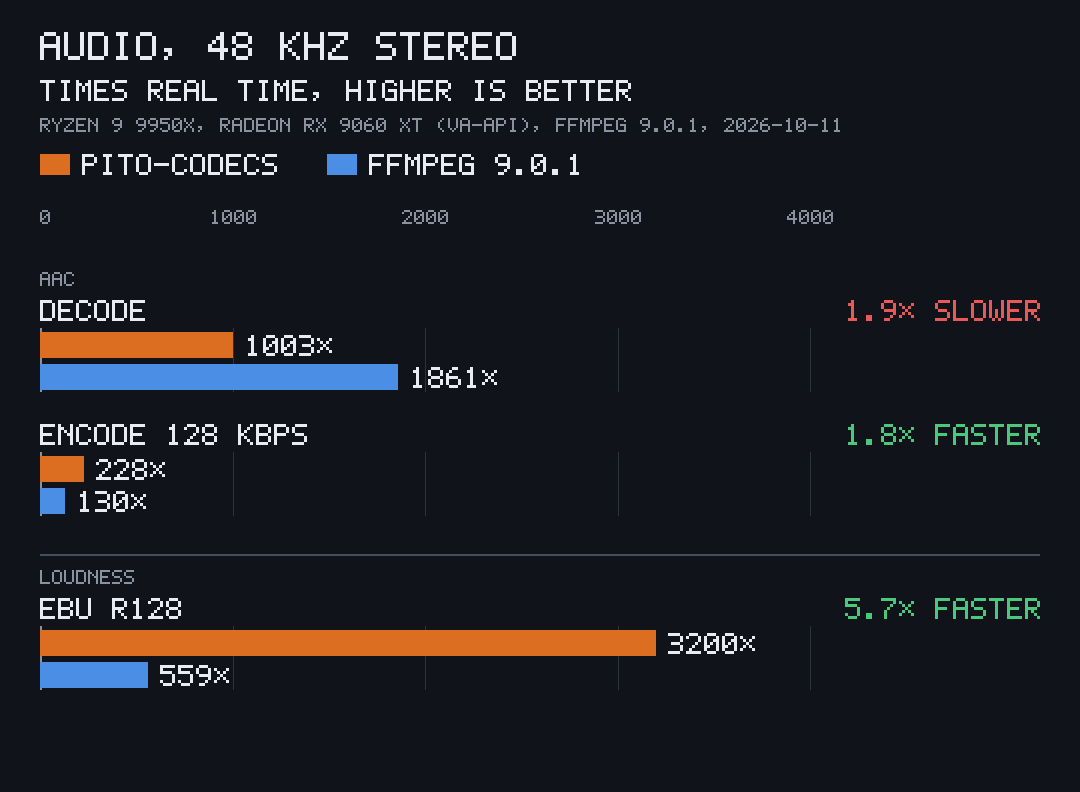
Ten minutes of 5.1 AC-3 at 448 kbps decode in 0.56 to 0.59 s on one core, and ten minutes of stereo MP3 at 192 kbps in 0.32 s on one thread, level with ffmpeg; through audio_pcm_range to stereo both run about twice as fast as ffmpeg.
To write audio, export an edit with audio; the AAC and Opus encoders are also there on their own in pito_codecs::aac and pito_codecs::opus::enc.