
Measure the cost
The bench example measures what a tool and a reader pay per call, with the
files in the job folder it picks for itself:
cargo run --release --example benchOne run on an AMD Ryzen 9 9950X, Linux, Rust 1.97.1, on a busy machine (load average about 35), printed:
Job::progress 235.2 nsHandle::frame 26.0 nsWriter::event, one line 237.3 nsLine::parse, one line 777.4 nsread_dir, per record 3688.9 nsjob record on disk 453 BJob::progress, PITO_JOBS=off 138.3 nsNumbers move from run to run with the machine’s load. The chart and table below are the run of 2026-10-14 on the same machine at a load of about 70, which the overview quotes:
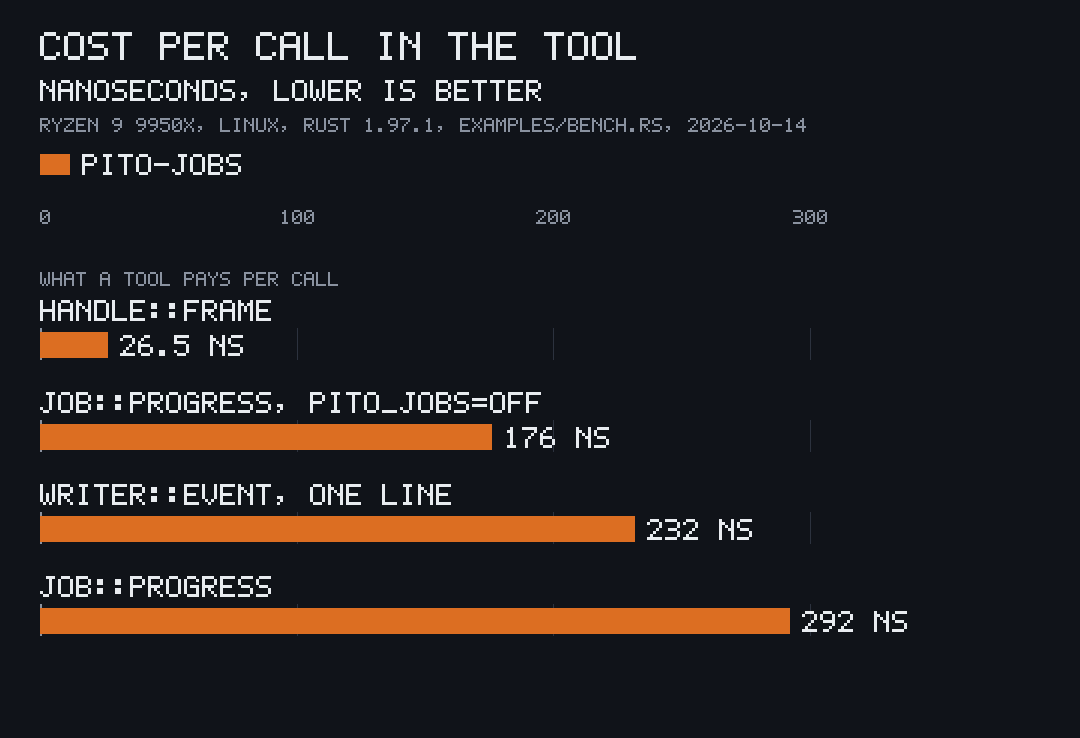
| Call | Cost | How |
|---|---|---|
Handle::frame |
26.5 ns | 5,000,000 frames into a live heartbeat |
Job::progress |
292.2 ns | 5,000,000 calls on a live job, its file rewritten once a second |
Job::progress, PITO_JOBS=off |
176.0 ns | the same with every write off |
Writer::event |
231.7 ns | 1,000,000 progress lines into io::sink |
Line::parse |
670.7 ns | 1,000,000 parses of one progress line |
read_dir |
4.2 µs a record | 2,000 reads of a folder of 32 job records |
| A job record on disk | 454 bytes | the benchmark’s own record |
At 60 fps a frame has 16.7 ms, so Handle::frame costs 0.00016% of it, and
a progress call per frame is under 0.002%.